

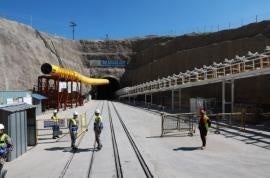
The 38.5km-long Polihali Tunnel is one of the scheme’s major components.
The first TBM was commissioned at Katse Dam in February 2025 and has started tunnel drilling at the Katse site. The two TBMs will excavate through the Maluti Mountains from opposite ends, ultimately connecting the Polihali and Katse reservoirs.
Each machine is 5.38m in diameter and approximately 423m long.
The R9.2bn (€480m) project also includes a 165m-high concrete-faced rockfill dam at Polihali, located downstream of the confluence of the Khubelu and Senqu-Orange rivers, and the 800m-long Senqu Bridge.
The LHWP aims to harness the Orange–Senqu River system through a network of dams and transfer tunnels to boost water supply to South Africa’s Integrated Vaal River System, which supports the country’s economic hub in Gauteng.
Through the new 2.322 million m3 capacity Polihali reservoir, Phase II is expected to progressively add 490 million m3 to the existing 780 million m3 transferred to South Africa annually.
The project will also to hydropower generation in Lesotho.
At yesterday’s event, which was attended by South African and Lesotho government ministers, South Africa’s minister of water and sanitation, Pemmy Majodina, described the project as “engineering at its most purposeful”.
“This is infrastructure at its most transformative,” she said.


