

The rehabilitation programme on external linings of Italian motorway tunnels is gaining a significant planning boost from new digital workflow systems developed for Gruppo Autostrade per l’Italia (ASPI).
ASPI’s programme is focused on tunnels that show signs of structural decay in the outer linings after decades of operation. The digital workflow boost is being managed by Tecne Systra-Sws Advanced Tunnelling Srl, or Tecne Systra – formed from the merger between ASPI’s Tecne and Systra-SWS. The company has a focus on developing intervention projects to improve safety, efficiency, and sustainability of the ageing motorway tunnel assets.
The rehabilitation initiative addresses tunnels constructed between the 1960s and 1970s that now require structural renewal and reinforcement in compliance with national guidelines for tunnel risk management and classification.
“The rehabilitation works reduce or eliminate risks of possible hazards due to structural decay and ensure suitable performance in case of seismic events,” says Ana Emiliano dos Reis, manager for Building Information Modelling (BIM) at Tecne Systra.
For the initiative, Tecne Systra implemented digital workflows to support both the assessment of improvement needs in the tunnels as well as rehabilitation works. The approach has been delivering improved design efficiency and giving the basis for longterm asset management.
The strategy for greater use of digital workflows reflects a wider shift to data-driven design processes and coordinated information management across project stages within such a large investment programme.
The interventions aim to extend asset lifetime by building new, structurally autonomous linings, or reinforcing existing structures.
A multidisciplinary team working with the enhanced digital workflow comprises civil, geotechnical, road, hydraulic engineers, and geologists – alongside the digital systems specialists.
COMPLEXITY ACROSS DISCIPLINES
The rehabilitation programme encompasses investigative surveys evaluating existing tunnel conditions whilst providing design, demolition, and reconstruction recommendations.
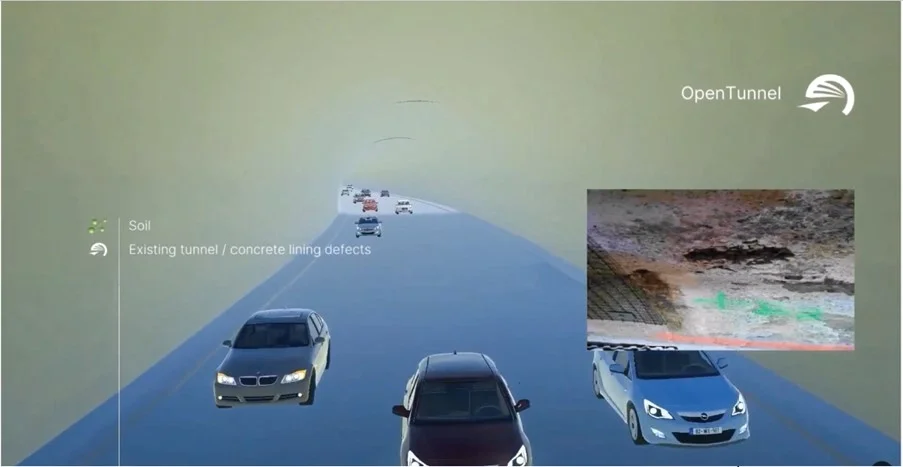
Extending tunnel lining lifecycle requires comprehensive intervention works, ranging from soil consolidation and partial demolition of tunnel lining to steel mesh and cast-in-place concrete reinforcement alongside waterproofing and drainage installations.
For the rehabilitation programme, the main challenges are: managing high volumes of inspection and investigation data; increasing data interpretation capability; defining standardised procedures applicable across all individual tunnel improvement projects; and, ensuring interventions deliver security and safety improvements, so extending tunnel life for 50 years.
Additionally, impacts on highway traffic need to be minimised while at the same time optimising structural interventions through automation and accelerated operations.
Better decision-making would come from enhanced data accessibility, requiring successful digitalisation, recognised Tecne Systra.
“The digital project is then developed in different phases according to the construction sequence from demolition of portions of the existing lining up to the reconstruction phase,” says Emiliano dos Reis.
DIGITAL APPROACH
To establish the required connected digital environment, Tecne Systra chose applications from Bentley Systems. By introducing OpenTunnel Designer, the team developed digital workflows and 3D tunnel models that covered investigative surveys, including flat jacks, borehole TV cameras, core drilling stratigraphy, laser scanning, geo-radar, and in-depth inspections.
“We have chosen OpenTunnel Designer because it is the first and only purpose-built software for tunnel modelling and design,” says Emiliano dos Reis.
Tecne Systra combined geological models through Leapfrog, geotechnical models through PLAXIS, steel structural models through ProStructures, and civil models including water and drainage – all capable of real-time updates. LumenRT was also utilised.
The platform also supported the integration of alignment data generated in external design software. Project data and work breakdown structures were exported using IFC standards to third-party cloud platforms, allowing stakeholders to access, manage, and exchange information throughout the project lifecycle.
Three coordinated models were developed: one representing existing conditions; one documenting demolition phases; and, one capturing the proposed works. Together, these models form a structured digital record of the asset and its interventions.
Emiliano dos Reis adds: “The existing demolition, as well as proposed information models, represent a database of what existed, what supported the design decision, what was demolished, and all the interventions made – soil consolidation, waterproofing and drainage system, steel mesh reinforcement, and cast-in place concrete – that can and should be used as a basis for future interventions.”
IMPLEMENTATION AND RESULTS
The transition to digital workflows has delivered substantial efficiency improvements across project delivery for the motorway rehabilitation programme.
“Going digital in the design phase allowed us to increase the capability of integration and valuation for a better survey data interpretation to support design decisions,” she says.
The team reports a 30% reduction in the time required to verify and interpret survey information.
Interoperable modelling tools also improved coordination between structural, drainage, and waterproofing systems, reducing design conflicts and streamlining option analysis. Compared with traditional workflows, overall project delivery time was reduced by about a fifth and modelling time by a quarter.
The digital approach enabled the simulation of multiple intervention scenarios prior to construction, which helped both material optimisation and constructability reviews. Enhanced collaboration between design and site teams has also helped to improve resolution of issues as well as supported more efficient construction planning.
FUTURE DEVELOPMENT
In adopting open IFC standards, Tecne Systra has set up a framework for long-term data reuse and model compatibility across asset management systems.
Additionally, the design and construction information models that were developed in the programme are a foundation to implement Digital Twins that can help support future activities in inspection, maintenance, and facility management.


